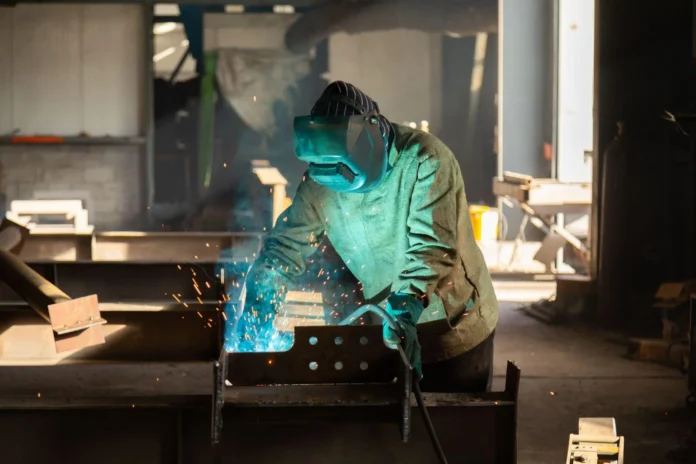

Photo: Collab Media
If you follow technology news even casually, you have likely noticed a recurring theme over the past few weeks. Almost every major industrial announcement seems to promise that artificial intelligence is about to magically rewrite the rules of physical production. We are flooded with visions of fully autonomous plants, self-correcting assembly systems, and digital brains managing entire supply chains from a cloud dashboard.
It sounds extraordinary on paper. Yet, if you leave the executive suites and step directly onto an active production floor, a very different picture emerges.
The immediate challenge facing most factories today is not a lack of algorithms. It is the simple, stubborn reality of how human beings execute work under pressure. While corporate strategy meetings obsess over the newest AI tools, the men and women assembling complex machinery are often still handed static paper printouts, flat PDF binders, or disconnected screenshots. The grand vision of digital progress drops off sharply right at the point of work.
The Invisible Friction of Bad Instructions
When we talk about artificial intelligence in industry, we tend to talk about grand, sweeping ideas. We imagine predictive maintenance models or automated scheduling engines. But we rarely stop to consider the smaller, human frictions that quietly erode productivity every single day.
Consider what actually happens when a line worker encounters an ambiguous assembly step.
When an instruction is presented as a dense wall of text or a flat, two dimensional drawing, the human brain has to do extra work. The operator has to pause, interpret the spatial orientation, and mentally translate a static image into a physical action.
If the part has been slightly modified by engineering, that worker might have to step away from their station, track down a supervisor, or sift through a buried digital folder to find out what changed.
None of these pauses trigger a red alarm on a management dashboard. The assembly line does not dramatically grind to a halt. Instead, the plant loses five minutes here, three minutes there, and a fraction of quality everywhere. It is a slow, quiet tax on human energy, and it happens thousands of times a week across the industrial landscape.
Transforming How Instructions Are Built
This exact disconnect is what makes the practical application of new technology so compelling when it focuses on the right problems. Garth Coleman, the Chief Executive Officer of Canvas Envision, has been closely observing how these operational gaps affect frontline teams. His view is that the primary reason factories still rely on outdated documentation comes down to a hidden bottleneck: authoring.
Creating clear, interactive, and highly visual step by step guides has traditionally required immense time and technical effort. A manufacturing engineer would have to spend hours slicing up CAD models, taking manual screenshots, writing explanatory notes, and formatting documents for distribution. Because authoring was such a heavy burden, instructions were rarely updated as fast as product designs evolved.
By applying artificial intelligence directly to the authoring process itself, that equation changes completely.
Instead of forcing engineers to manually format every step, intelligent tools can analyze complex 3D engineering models, videos, or raw technical files, automatically proposing a logical visual sequence for the builder. What used to take hours or days can happen in minutes.
When you remove the friction of creating good instructions, you make it possible to give frontline workers clear, dynamic, and interactive guidance that matches the exact state of the engineering design.
Under the traditional authoring cycle, manual CAD slicing and manual screenshots required hours or days spent formatting documents, which meant documentation lagged far behind engineering updates.
By contrast, an AI assisted visual execution framework relies on instant sequence generation from 3D models, taking only minutes to generate visual guidance and ensuring real time alignment between design and execution.
Meeting a New Generation on Their Own Terms
This evolution matters even more when you look at the human workforce standing at the machines.
The industrial sector is navigating a massive generational transition. Experienced veterans who carried decades of unwritten intuition in their heads are reaching retirement age, taking invaluable institutional memory with them. At the same time, a new generation of workers is entering the workforce.
These younger employees are digital natives. They grew up learning how to fix appliances, build projects, or navigate complex tasks through clear, responsive visual media. Expecting them to sit at a bench and read through an abstract, sixty page text document before starting a job is completely out of step with how they process information.
Giving a new worker an interactive 3D guide that allows them to rotate parts, inspect spatial relationships, and see exactly how a step comes together does something remarkable. It strips away the anxiety of guesswork. It builds immediate confidence, shortens the onboarding curve from months to days, and respects the worker’s time and intelligence.
The Real Future of Production
The narrative around modern manufacturing needs a shift in perspective. Progress is not about replacing human hands with machines, nor is it about collecting vast oceans of data just to display them on executive screens.
The real breakthrough happens when technology makes human execution simpler, safer, and more precise. By bridging the gap between high level engineering designs and the person standing on the floor holding the tools, organizations can protect their operational momentum and build a workplace where people genuinely thrive.
Artificial intelligence will certainly continue to evolve, but its true value won’t be measured by how sophisticated the code sounds in a boardroom presentation. It will be measured by whether it makes the daily life of the frontline worker clearer, smoother, and more rewarding.